How it works
Crawl spaces need a coordinated approach to ground moisture, drainage, air leakage and thermal protection. Insulation alone cannot solve standing water or high humidity.
A whole-space approach to comfort and moisture.
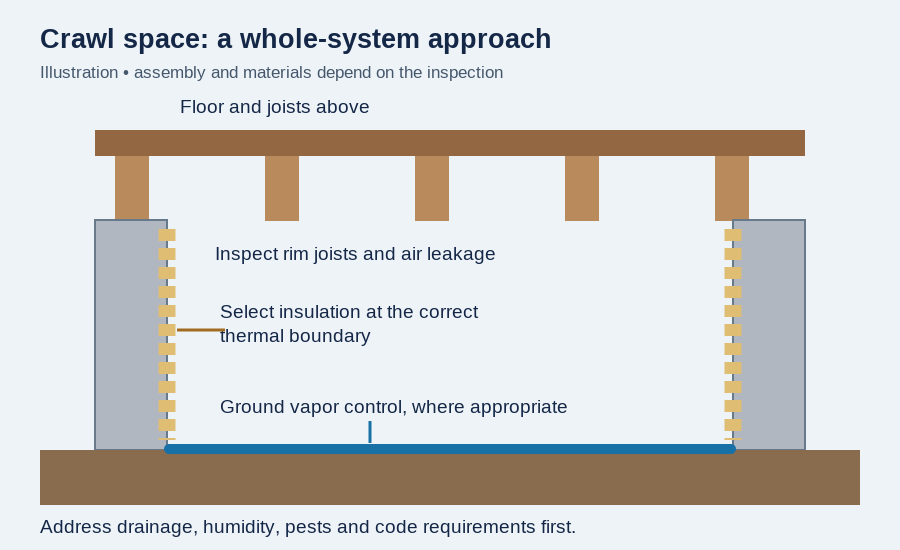
Evaluate drainage, ground vapor control, ventilation strategy and the floor or wall assembly before selecting insulation.
No. Water intrusion and humidity must be addressed separately.
We use this diagram to explain the assembly. We do not yet have a verified crawl-space project photograph in the supplied archive.
We check access, existing insulation, plumbing, ground moisture, drainage, ventilation and signs of deterioration. A vented floor assembly and a sealed crawl space require different designs. A ground vapor retarder is not a substitute for correcting bulk-water entry. We recommend materials and an installation scope only after evaluating the conditions.
Crawl spaces need a coordinated approach to ground moisture, drainage, air leakage and thermal protection. Insulation alone cannot solve standing water or high humidity.
Closed-cell foam may be useful in selected rim joist or foundation assemblies; fiberglass may suit properly detailed dry floor assemblies. Encapsulation may require a sealed ground vapor retarder and humidity control.
Inspect for leaks, pests, wood damage and combustion equipment. Do not conceal wet materials or assume foam replaces a ground moisture barrier.
That depends on whether the crawl space is vented or designed as a conditioned enclosure.